Autonomous Robotics Competition - Eurobot

Designed and built two autonomous robots for international Eurobot competition, achieving 121-point strategy through multi-robot coordination and precision control systems.

DURATION
Jan 2023 - May 2023
ROLE
Electrical Engineer
Grade
First Class (70%)
TEAM SIZE
5 Members

Project Gallery

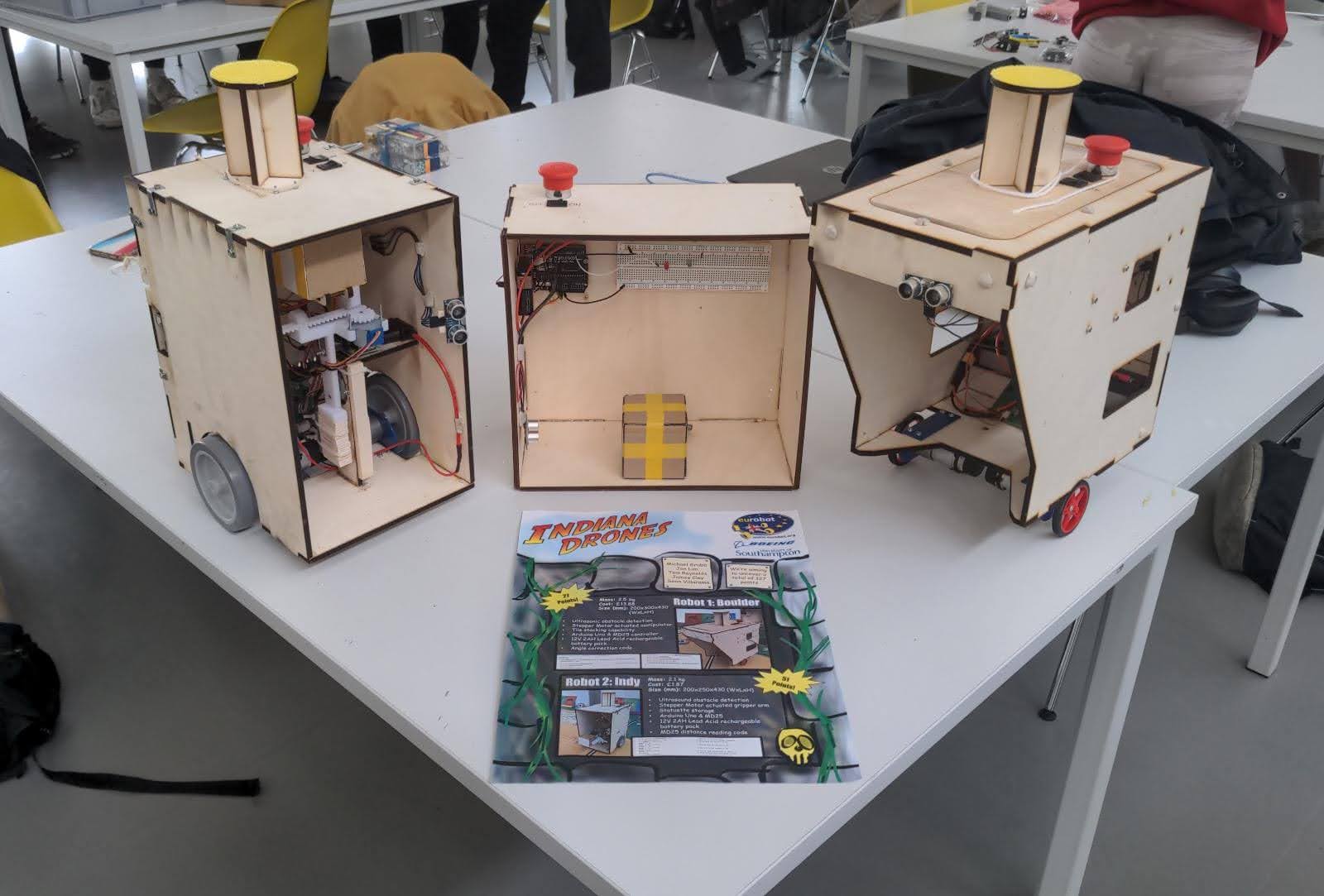
Indiana and Boulder - our autonomous robot team

Project Overview

Objectives

  • Design two specialized autonomous robots for Eurobot "Age of Bots" competition theme
  • Implement coordinated multi-robot strategy scoring 121 points (93 on table + 28 bonus)
  • Develop precision object manipulation systems for archaeology-themed tasks
  • Integrate Arduino-based control with encoder feedback for accurate positioning
  • Complete full design-to-manufacture cycle within one semester timeline

Key Achievements

  • Two specialized robots: "Indiana" for statuette manipulation, "Boulder" for tile handling
  • Rack and pinion actuator system with 90° rotation for precise object grabbing
  • Servo-driven screw mechanism enabling rapid tile pickup and manipulation
  • HC-SR04 ultrasonic sensors for object detection and collision avoidance
  • Successfully competed in national Eurobot competition with functional autonomous systems

Technical Details

Robot Specifications & Design

Dual-robot autonomous system with specialized mechanisms and coordinated strategy:

Robot 1 - "Indiana"

  • Primary Function: Statuette and replica manipulation with 90° rotating arm
  • Actuator: Rack and pinion grabber driven by dual 28BYJ-48 stepper motors
  • Storage System: Internal shelf mechanism for replica storage and deployment
  • Strategy: Precise slow movement for pedestal alignment and display cabinet operations
  • Scoring: 49 points through statuette display and excavation square activation

Robot 2 - "Boulder"

  • Primary Function: High-speed tile manipulation across competition surface
  • Dual Systems: Bottom-mounted rack & pinion scooper + servo-actuated screw grabber
  • Capacity: Pick up 2 tiles simultaneously, push 3 tiles at once
  • Wheels: Smaller diameter with enhanced tyres for precise movement
  • Scoring: 24 points through tile collection, gallery placement, and campsite delivery

Control Systems

  • Processor: Arduino UNO Rev3 boards for autonomous control logic
  • Motor Control: MD25 motor driver with EMG30 gear motors and encoders
  • Navigation: Encoder-based position tracking for accurate waypoint navigation
  • Sensors: HC-SR04 ultrasonic sensors (front and rear) for obstacle detection
  • Power: YUASA NP2-12 12V 2Ah battery for motors and electronics

Manufacturing & Materials

  • Structural Material: Laser-cut plywood for chassis and mounting plates
  • 3D Printing: Custom brackets and specialized components via FDM
  • Servos: MG996R servomotors for high-torque screw-driven grabber
  • Display Cabinet: Separate Arduino system with ultrasonic sensor and LED indicators
  • Budget: £447 total project cost including all components and materials

Core Technologies

Arduino

Autonomous control & sensors

SOLIDWORKS

Mechanical CAD design

C/C++

Arduino programming

3D Printing

FDM rapid prototyping
Key Contributions

Mechanical Design

  • Rack & Pinion System: Designed and prototyped grabber mechanism with 90° rotation capability for precise object manipulation
  • CAD Development: Created comprehensive SOLIDWORKS assemblies and part drawings for both robots
  • Structural Design: Optimized plywood chassis for minimal weight while maintaining rigidity
  • Manufacturing: Coordinated laser cutting and 3D printing operations for rapid iteration

Integration & Testing

  • System Integration: Assembled complete robots integrating mechanical, electrical, and control systems
  • Iterative Testing: Conducted extensive testing cycles to improve consistency and reliability
  • Performance Tuning: Optimized movement code for accurate waypoint navigation and task execution
  • Competition Preparation: Debugged systems and validated autonomous sequences for national competition

Team Collaboration

  • Design Reviews: Participated in iterative design reviews and concept evaluation sessions
  • Cross-functional Work: Collaborated with programming and electronics team members
  • Documentation: Contributed to technical report including assembly drawings and part specifications
  • Resource Management: Helped manage £447 budget across components and materials

Problem Solving

  • Consistency Issues: Identified and resolved robot positioning inconsistencies through encoder calibration
  • Design Constraints: Worked within strict competition regulations and 100-second time limit
  • Manufacturing Limitations: Adapted designs for available fabrication methods and budget constraints
  • System Reliability: Improved grabber mechanism reliability through material selection and tolerance optimization

Documentation & Resources

Technical Design Report

Comprehensive group report detailing robot design, specifications, testing procedures, and competition strategy for Eurobot 2023.

View Report