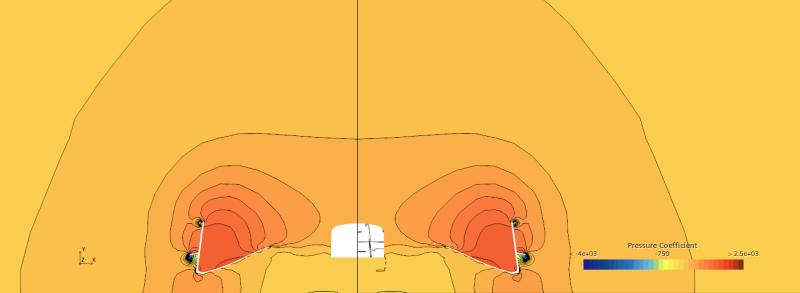
CFD Simulation Approach
Advanced computational fluid dynamics investigation using high-performance computing resources:
Simulation Setup
- • Software: Siemens Simcenter Star-CCM+ for Navier-Stokes equation solving
- • Computing: University of Southampton HPC (IRIDIS) facility
- • Models: Outsourced 3D geometry for 2021 and 2022 Formula One cars
- • Solver Type: Steady-state RANS with turbulence modeling
- • Analysis Focus: Vorticity fields, turbulence intensity, and wake structures
Aerodynamic Theory
- • Navier-Stokes: Fundamental fluid dynamics governing equations
- • Coanda Effect: Fluid adherence to curved surfaces for flow attachment
- • Vortex Generation: Understanding wingtip and bargeboard vortex formation
- • Ground Effect: Venturi effect and underbody downforce generation
- • Dirty Air: Turbulent wake impact on following car performance
Analysis Areas
- • Front Wing: Y250 vortex behavior and tip vortex shedding comparison
- • Tyre Wake: Wheel wake management and rim cover effectiveness
- • Bargeboards: Impact of 2022 removal on mid-car vortex reduction
- • Rear Wing: Endplate vortex elimination and wake turbulence analysis
- • Overall Wake: Axial velocity fields and upwash characteristics
Project Motivation
- • Research Gap: Limited modern F1 aerodynamic research in public domain
- • Regulation Impact: Major 2022 rule changes targeting turbulence reduction
- • Racing Quality: Improving overtaking through reduced dirty air effect
- • Industry Relevance: Analysis applicable to future regulation development
- • Fan Experience: Better racing quality benefits sport growth
Core Technologies
Star-CCM+
CFD simulation platform
ANSYS
Fluids theory reference
IRIDIS HPC
High-performance computing
F1 Models
2021/2022 car geometry