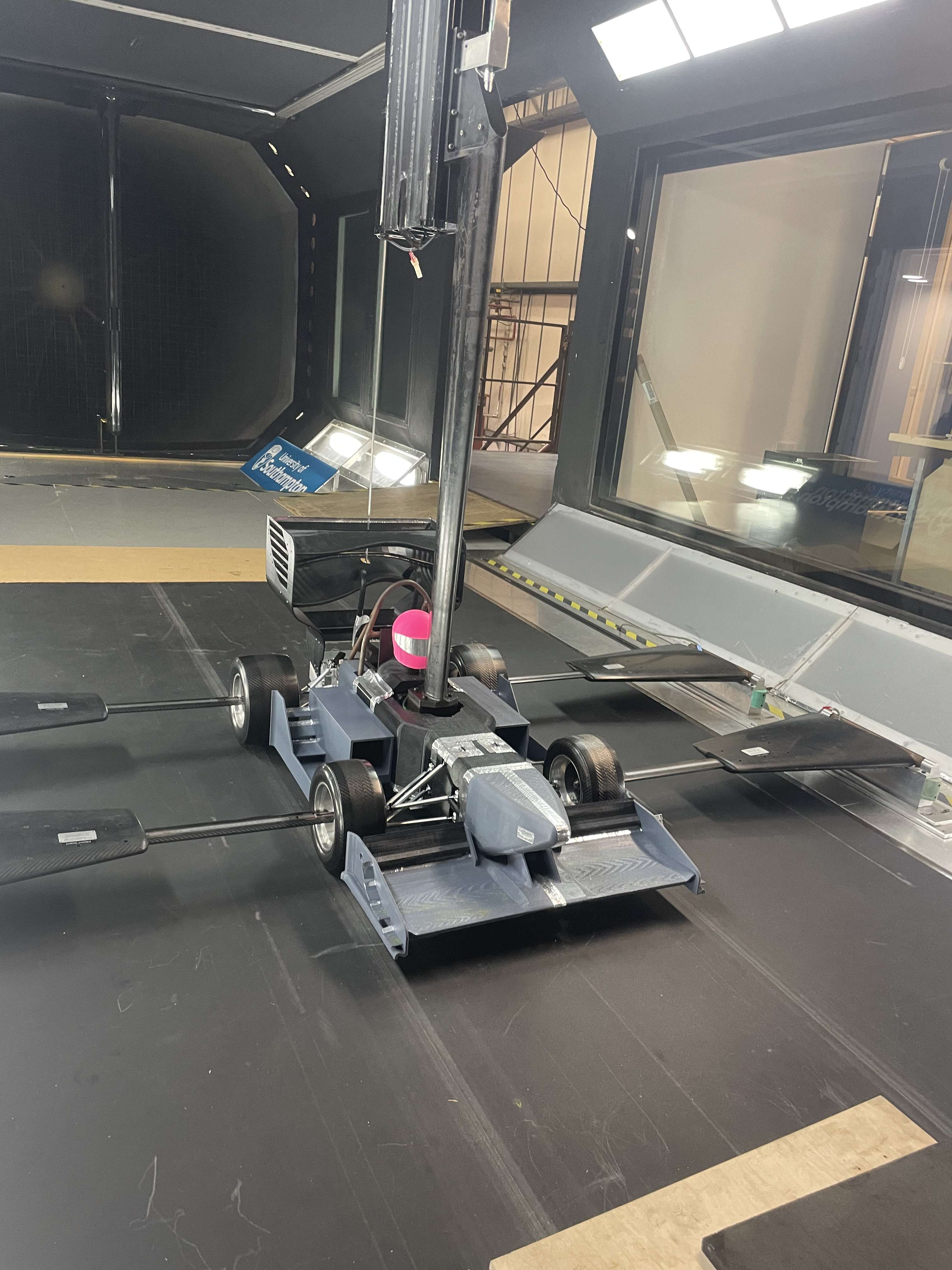
Aerodynamic Development of a Formula Student Car

Led CFD development and team management for a modular Formula Student BEV aerodynamic package, achieving 90% downforce retention with improved efficiency and validated through comprehensive wind tunnel testing.

DURATION
Sep 2023 - Jun 2024
ROLE
Team Leader & Aero Lead
GRADE
First Class (75%)
TEAM SIZE
5 Members

Project Gallery

Visual overview of the aerodynamic development process

Project Overview

Objectives

  • Develop modular aerodynamic package (front wing, sidepods, bodywork) compliant with FS 2024 regulations
  • Design and integrate cooling system for endurance event performance optimization
  • Manufacture 40% scale wind tunnel model with improved suspension reliability
  • Validate CFD simulations through RJ Mitchell wind tunnel testing with Reynolds similarity
  • Lead team coordination, CFD workflow development, and lap time simulation analysis

Key Achievements

  • First-class honors (75%) - Exceeded performance targets for downforce, drag, L/D efficiency, and lap time
  • 90% downforce retention with lower drag coefficient compared to previous design, maintaining near-identical lap times
  • Integrated functional cooling system enabling sustained endurance event performance for BEV powertrain
  • Successfully validated CFD model through wind tunnel testing with excellent repeatability
  • Developed comprehensive design framework suitable for future SUFST projects and educational use

Technical Details

Methodology & Technical Approach

Multi-disciplinary engineering approach combining advanced simulation, physical validation, and iterative design optimization:

CFD Development

  • • Established Star-CCM+ workflow on IRIDIS HPC facility
  • • Half-car symmetry simulations at 30 mph average speed
  • • Validated against previous year's design data
  • • Implemented rotating wheel boundary conditions

Cooling System Design

  • • MATLAB-based thermal modeling for BEV battery pack
  • • Sidepod radiator integration with flow optimization
  • • Adequate cooling for endurance event sustained performance
  • • Balanced thermal management with aerodynamic efficiency

Wind Tunnel Validation

  • • 40% scale model tested in RJ Mitchell wind tunnel
  • • Reynolds similarity maintained for accurate scaling
  • • Improved suspension system eliminating previous errors
  • • Excellent repeatability confirming CFD predictions

Performance Analysis

  • • OpenLAP MATLAB lap time simulation integration
  • • Iterative design optimization for L/D efficiency
  • • Collaborative SOLIDWORKS CAD development
  • • FDM manufacturing with PETG for recyclability

Core Technologies

MATLAB

Lap time simulation & thermal modeling

SOLIDWORKS

Collaborative CAD modeling

RJ Mitchell WT

Physical validation testing

Star-CCM+

HPC CFD simulations

Leadership & Key Contributions

Team Leadership

  • Project Setup: Established SharePoint collaboration space, scheduled regular meetings, and created skills matrix for transparent task delegation
  • Design Philosophy: Developed comprehensive flow field concept leveraging SUFST experience and F1 aerodynamics knowledge
  • Mentorship: Guided less experienced team members in CFD workflows and front wing design principles
  • Project Management: Adjusted scope from full redesign to focused iteration based on team capabilities and resources

CFD Lead Responsibilities

  • Workflow Development: Rebuilt entire Star-CCM+ workspace after inheriting unusable setup with meshing and solver errors
  • HPC Management: Sole team member with IRIDIS High-Performance Computing experience, managed all simulation jobs
  • Simulation Setup: Configured boundary conditions, rotating wheels, and domain parameters for 30 mph straight-line half-car simulations
  • Data Analysis: Conducted all post-testing CFD validation and wind tunnel data correlation analysis

Technical Deliverables

  • Sidepod Design: Developed new cooling-optimized sidepod with integrated radiators maintaining aerodynamic performance
  • Performance Tools: Sourced and configured OpenLAP MATLAB lap time simulator for design evaluation
  • Testing Operations: Primary computer operator during wind tunnel testing, controlling model movements and data acquisition
  • Manufacturing Support: Active participation in 40% scale model assembly and preparation

Sustainability & Innovation

  • Modular Design: Created reusable wind tunnel model suitable for future SUFST validation work and educational purposes
  • Material Selection: Specified PETG for FDM printing based on chemical resistance, impact strength, and recyclability
  • Component Reuse: Retrofitted rear wing, chassis, and roll hoop from previous year to minimize waste
  • BEV Optimization: Tailored aerodynamic philosophy specifically for battery electric vehicle efficiency requirements

Documentation & Resources

Project Presentation

Final presentation used to defend the project and showcase results to academic panel.

View Presentation

Personal Journal

Detailed documentation of personal contributions and learning throughout the project.

View Journal

Group Report

Final comprehensive project report detailing methodology, results, and conclusions.

View Report